Progressing Through Change: Resources
The four stage design used in Progressing Through Change was developed from two established models of change management:
- Kurt Lewin’s three-stage process of Unfreeze – Transition – Freeze
- Elizabeth Kübler-Ross’s Grief Cycle
Resources for Change Management
Resources for Leading Change
The Progressing Through Change Definitions and Strategies
So you can have it all in one easy-to-print location, here is all the info on the four PTC stages:
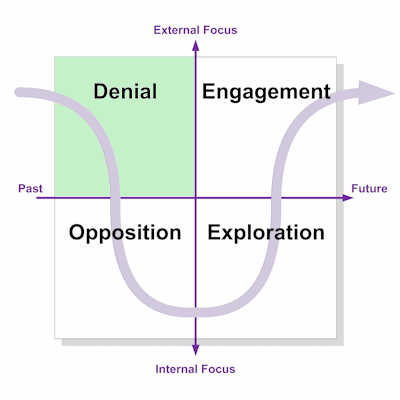
The Denial Stage
Avoiding – Ignoring – Not Perceiving
Denial Defined:
Denial is the normal initial reaction to change. It is a natural defense mechanism:
People refuse to acknowledge the existence of the coming change or the reasons for it.
People try to protect the past and their comfort level by ignoring the change.
It is often hard to recognize denial in yourself. Even those who welcome change will
likely go through a period of denial as they adjust to the change. Denial is a healthy
part of the change process because it minimizes anxiety and disruption during the early
part of the change. However, denial can become destructive if people refuse to accept
that change is necessary.
People in Denial:
- Avoid the topic
- Appear unconcerned
- Will not take initiative
- Act like nothing is happening
Denial Quotations:
- “Yet another shake up – but nothing ever really changes”
- “Change? What change? Looks like the same old, same old to me.”
- “This change will blow over just like all the others.”
- “They will change their minds and we’ll revert back in no time.”
Denial Strategies:
Listed below are a few strategies you can use to help move from the denial stage into the resistance stage.
- Draw a line down the middle of a sheet of paper. On the left side of the line, list all the dangers
the change may hold for you. On the right side of the line, list all the opportunities it may hold for you.
- Envision how things will look in five years and imagine what your role will be in that future.
- Visit the resource section to learn more about progressing through the change process.
The Opposition Stage
Anger – Anxiety – Depression – Fear
Opposition Defined:
People in the opposition phase have acknowledged the change, but they haven’t “bought-in” yet.
They are uncomfortable with the change and don’t know what is expected of them or how they are
supposed to accomplish their goals. They would prefer to prevent the change from happening.
An individual in opposition may actively resist change by arguing or passively resist by continuing
to do things the old way. Individuals in this phase are still focused on what they will lose
instead of what they will gain from the change. Opposition is a normal, important stage in
progressing through change. It gives the individual an opportunity to vent and adjust to the
change. Opposition should be actively engaged to reveal issues that must be addressed to
successfully progress through the change.
People in Opposition:
- Show anger
- Complain and blame others
- Become passive
- Become exhausted and overwhelmed
Opposition Quotations:
- “We would be better off the way things used to be.”
- “They can’t think I’m going to do this on top of everything else I have.”
- “This whole thing is a bad idea. It will not work.”
- “If management hadn’t blown it three years ago, this never would have happened.”
Opposition Strategies:
Listed below are a few strategies you can use to help move from the opposition stage into the exploration phase.
- Minimize your stress by focusing on the “Mastering” and “Letting Go” areas on the personal power grid
shown below. List aspects of the change that you have control over and should master. Then list
aspects of the change that you do not have control over and should let go.
Personal Power Grid

The personal power grid plots control against action. As shown in the grid, you should take action in areas
where you have control (Mastering). You should not take any action in areas where you do not have control
(Letting Go). By focusing on what you control and letting go of what you do not, you will not miss
opportunities (Giving Up) or waste your time (Spinning Wheels).
|
- Meet with your manager to discuss your concerns about the change and how your work will change.
- Rather than affixing blame for the change, review all the information available and
identify the forces that created the need for this change.
- Visit the resource section to learn more about progressing through the change process.
The Exploration Stage
Learn New Ways – Discover Opportunities – Create Solutions
Exploration Defined:
In the exploration stage, people are taking some control back. They have accepted the change
is necessary and are figuring out what needs to be done and how to do it. It is a period of
investigation and innovation – finding better ways to accomplish new goals. Exploration is the
fun stage. People become more collaborative and their enthusiasm and energy increase. Exploration
is the growing stage. It gives individuals the opportunity to plan, learn, and discover how to
make the change work for them. Individuals in exploration may have trouble staying focused. They
must focus the energy generated in this stage to developing a change plan and moving into the
commitment stage.
People in Exploration:
- Experiment
- Seek new ways
- Envision possible futures
- Generate lots of ideas
Exploration Quotations:
- “We're on a rough stretch, but this change has great possibilities.”
- “It’s about time we got ourselves back on course.”
- “I’ve got some great ideas we finally can try out now.”
- “I am learning so much that I never knew before.”
Exploration Strategies:
Listed below are a few strategies you can use to help move from the exploration stage into the commitment phase.
- With your team or manager, brainstorm new ideas on how to accomplish more after the change.
Then select the most promising ideas and investigate how they could be implemented.
- Identify the new skills you will need to develop to succeed.
Then use all the resources available to you to find the learning you need.
- Meet with you manager to develop an individual performance and development plan.
- Visit the resource section to learn more about progressing through the change process.
The Engagement Stage
Renewal – Focus – Realize Benefits
Engagement Defined:
In the engagement stage, people align themselves with the change and adopt behaviors to
make the change work. Their new ways of doing things becomes their “normal” way of behaving.
The individual has a sense of shared purpose and increased self-confidence. Individuals in
the engagement stage should reward themselves for their progress through the change. You
should not become too comfortable in the engagement stage. Another change is inevitable.
You should reflect on the change process you just went through and note strategies that
will help you through the next change.
People in Engagement:
- Sense that they are in control
- Are comfortable
- Reflect on what they have learned
- Start looking ahead to the next change
Engagement Quotations:
- “We are primed to be very successful this year.”
- “Things are working so much better since the re-organization.”
- “I am getting a lot of great work done now.”
- “We have come out of this change much better prepared for the next change.”
Engagement Strategies:
Listed below are a few strategies you can use to help move through the commitment stage and
prepare for the next change.
- Recognize the effort you have put forth to progress through the change and give yourself a reward.
- Recognize the effort your friends and co-workers have put forth to support the change by
sending them a note.
- Meet with your manager to review your work plan to make sure it accurately reflects
your performance and development objectives.
- Look ahead to possible future changes and envision how you might prepare for and respond to those changes.
|